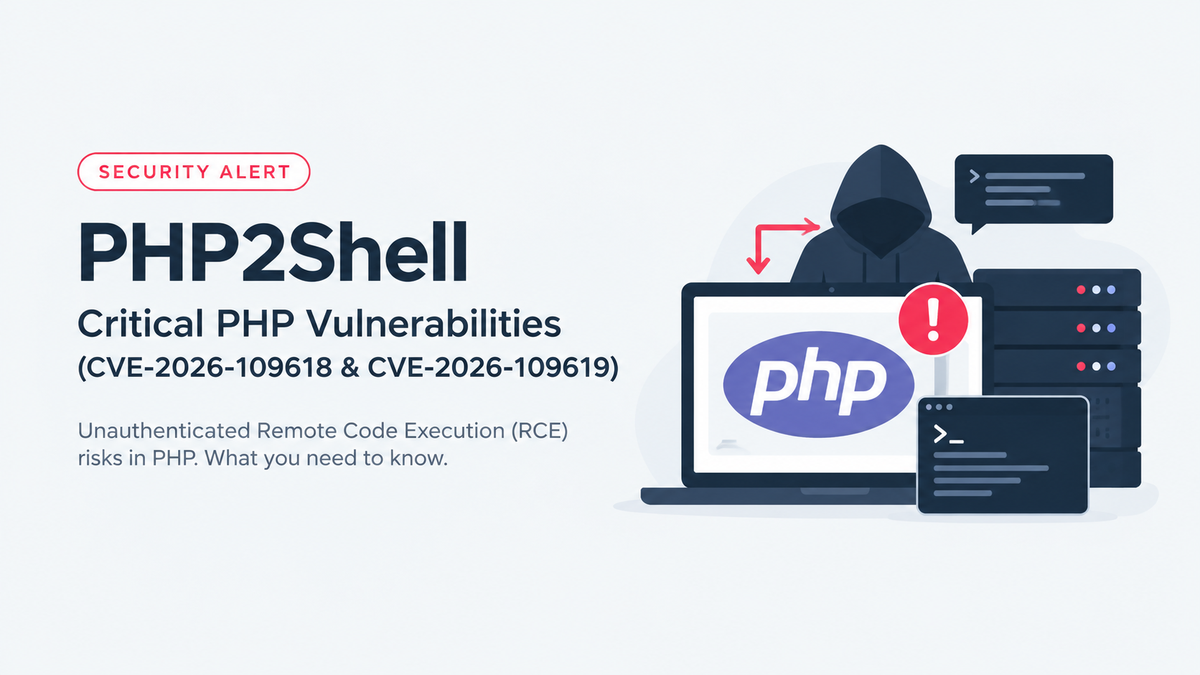
PHP2Shell Explained: Understanding the Critical PHP Vulnerabilities (CVE-2026-109618 & CVE-2026-109619)

Introduction
When security vulnerabilities affect a widely deployed technology, the consequences often extend far beyond individual organizations. That is precisely the case with PHP2Shell, the name given to two critical Remote Code Execution (RCE) vulnerabilities tracked as CVE-2026-109618 and CVE-2026-109619.
Unlike application-specific vulnerabilities that impact a single framework or plugin, PHP2Shell affects the PHP runtime itself. Since PHP powers millions of websites, APIs, and enterprise applications, a flaw in the runtime immediately expands the attack surface across a significant portion of the internet.
Following the disclosure on October 21, 2026, security vendors, hosting providers, and incident response teams urged organizations to update affected systems immediately. Reports of exploitation attempts appearing shortly after public disclosure further reinforced the urgency of applying available patches.
In this article, we'll examine how PHP2Shell works, why security professionals consider it one of the most significant PHP vulnerabilities in recent years, and what organizations should do to protect their infrastructure.
Executive Summary
PHP2Shell refers to two critical vulnerabilities in PHP that may allow unauthenticated Remote Code Execution (RCE) under specific conditions.
The vulnerabilities affect PHP's internal memory management and request processing logic rather than any individual application built on top of PHP. As a result, websites running WordPress, Laravel, Drupal, Magento, Symfony, Joomla, WHMCS, or custom PHP applications may all be vulnerable if the underlying PHP runtime has not been updated.
Although exploitation requires carefully crafted requests, successful attacks could allow an adversary to execute arbitrary commands, deploy web shells, steal sensitive information, and completely compromise affected servers.
For organizations operating internet-facing PHP applications, patching should be treated as a high-priority security task.
Technical Analysis
PHP2Shell consists of two independent vulnerabilities that affect different parts of PHP's request handling process.
CVE-2026-109618 — Out-of-Memory Memory Corruption
The first vulnerability originates from PHP's handling of Out-of-Memory (OOM) conditions.
When PHP reaches its configured memory limit while processing a request, execution may terminate before several internal objects have been fully initialized. During cleanup, PHP may incorrectly treat these partially initialized objects as valid structures.
Researchers demonstrated that this behavior creates a memory corruption primitive which, under carefully controlled conditions, can be transformed into arbitrary code execution.
Although the underlying implementation involves complex memory management routines, the practical impact is clear: attackers may gain the ability to execute their own code on the target server without authentication.
CVE-2026-109619 — Stale Request State Reuse
The second vulnerability affects PHP's internal request lifecycle.
Throughout normal request processing, PHP stores temporary state information that should be discarded after execution completes. Under certain conditions, portions of that state may remain accessible after the associated memory has already been released.
If a subsequent request reuses that stale memory before proper reinitialization occurs, attackers can manipulate PHP's internal execution flow and trigger memory corruption.
Researchers successfully demonstrated that this primitive could also be developed into Remote Code Execution on vulnerable systems.
Exploitation Scenario
Unlike many vulnerabilities that require stolen credentials or administrative access, PHP2Shell can potentially be exploited by sending specially crafted HTTP requests to an affected server.
A typical attack would follow this sequence:
- The attacker identifies a publicly accessible PHP application.
- A malicious request triggers one of the vulnerable execution paths.
- PHP's internal memory becomes corrupted.
- The attacker gains arbitrary code execution.
- Additional malware, web shells, or persistence mechanisms are deployed.
Because exploitation targets PHP itself rather than the application, the attack can affect a broad range of websites regardless of which framework or CMS they use.
Business Impact
For many organizations, the consequences extend beyond technical compromise.
A successful attack could expose sensitive customer information, interrupt online services, deploy ransomware, or allow attackers to establish long-term persistence inside production infrastructure.
Organizations operating shared hosting environments or managed platforms may face additional risk because multiple customer applications often rely on the same PHP runtime.
Potential impacts include:
- Remote Code Execution
- Complete server compromise
- Website defacement
- Database theft
- Credential exposure
- Ransomware deployment
- Service disruption
- Regulatory and compliance violations
Who Is Affected?
Any organization running vulnerable versions of PHP should consider itself potentially affected.
This includes environments hosting:
- WordPress
- Laravel
- Drupal
- Magento
- Joomla
- Symfony
- MediaWiki
- WHMCS
- Custom PHP applications
- Internal business portals
- PHP-based REST APIs
It is important to understand that updating WordPress or another CMS alone does not remediate the issue. The underlying PHP runtime must also be updated.
Mitigation and Recommendations
The most effective mitigation is to upgrade PHP to a patched release provided by the PHP development team or your operating system vendor.
After updating PHP, administrators should restart PHP-FPM, Apache, Nginx, IIS FastCGI, or any other services responsible for executing PHP code to ensure patched binaries are loaded.
Organizations should also review unsupported PHP installations. Legacy versions that no longer receive security updates present a significantly higher long-term security risk and should be upgraded as soon as practical.
Beyond patching, organizations should strengthen monitoring for unusual PHP crashes, unexpected administrator accounts, suspicious outbound connections, newly created web shells, and unauthorized file modifications.
Defense-in-depth controls such as Web Application Firewalls (WAFs), endpoint monitoring, network segmentation, and least-privilege access can further reduce the impact of successful exploitation.
Final Thoughts
PHP2Shell serves as another reminder that vulnerabilities affecting foundational technologies can have internet-wide consequences.
Unlike application-level flaws that impact a single product, vulnerabilities in widely deployed runtimes such as PHP immediately affect thousands of organizations across multiple industries.
The good news is that organizations can significantly reduce their risk by maintaining an accurate software inventory, applying vendor patches promptly, monitoring for indicators of compromise, and following established vulnerability management practices.
As attackers continue to move faster after public disclosures, timely patch management is no longer just an operational best practice—it is a critical component of modern cybersecurity resilience.