Traefik Security Alert: 8 Vulnerabilities in 12 Days — Is Your Infrastructure Safe?
Eight vulnerabilities. Two security updates. Just twelve days apart. Even recently patched Traefik deployments may remain exposed to authentication bypass, credential leaks and denial-of-service attacks. Here's what infrastructure teams need to know.

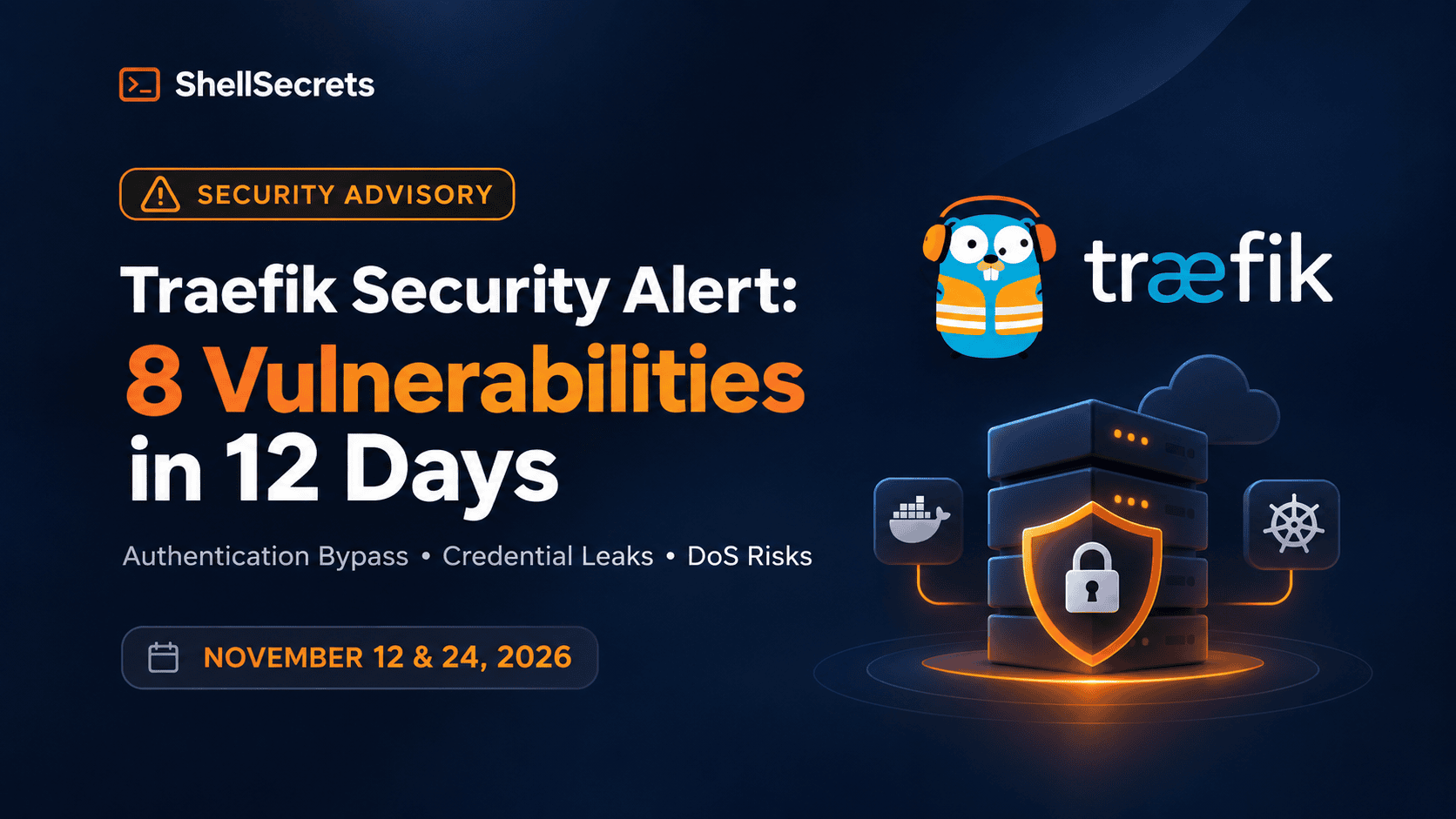
On November 12 and November 24, 2026, Traefik Labs released security updates addressing vulnerabilities that could allow authentication bypass, expose infrastructure credentials, undermine TLS security policies and exhaust system resources.
Of the eight vulnerabilities, five are classified as high severity and three as moderate.
Even if you updated Traefik following the November 12 security announcement, your infrastructure may still be exposed to vulnerabilities addressed in the November 24 release.
For businesses running Docker, Kubernetes or internet-facing applications behind Traefik, these disclosures deserve immediate attention.
A reverse proxy sits at a critical infrastructure boundary. When that boundary fails, the consequences can extend across every application it protects.
Let's examine what happened, which deployments are affected and how to secure your infrastructure.
Security advisory: This article covers the Traefik security disclosures published on November 12 and November 24, 2026, based on official vendor advisories available as of November 27, 2026.
Traefik Security Vulnerabilities: What Happened?
Traefik Proxy is widely used in modern infrastructure to manage application routing, load balancing, TLS termination, authentication and dynamic service discovery.
Its integration with Docker and Kubernetes makes it particularly valuable in environments where applications and services frequently change.
However, its position between clients and backend applications also makes it a critical security boundary.
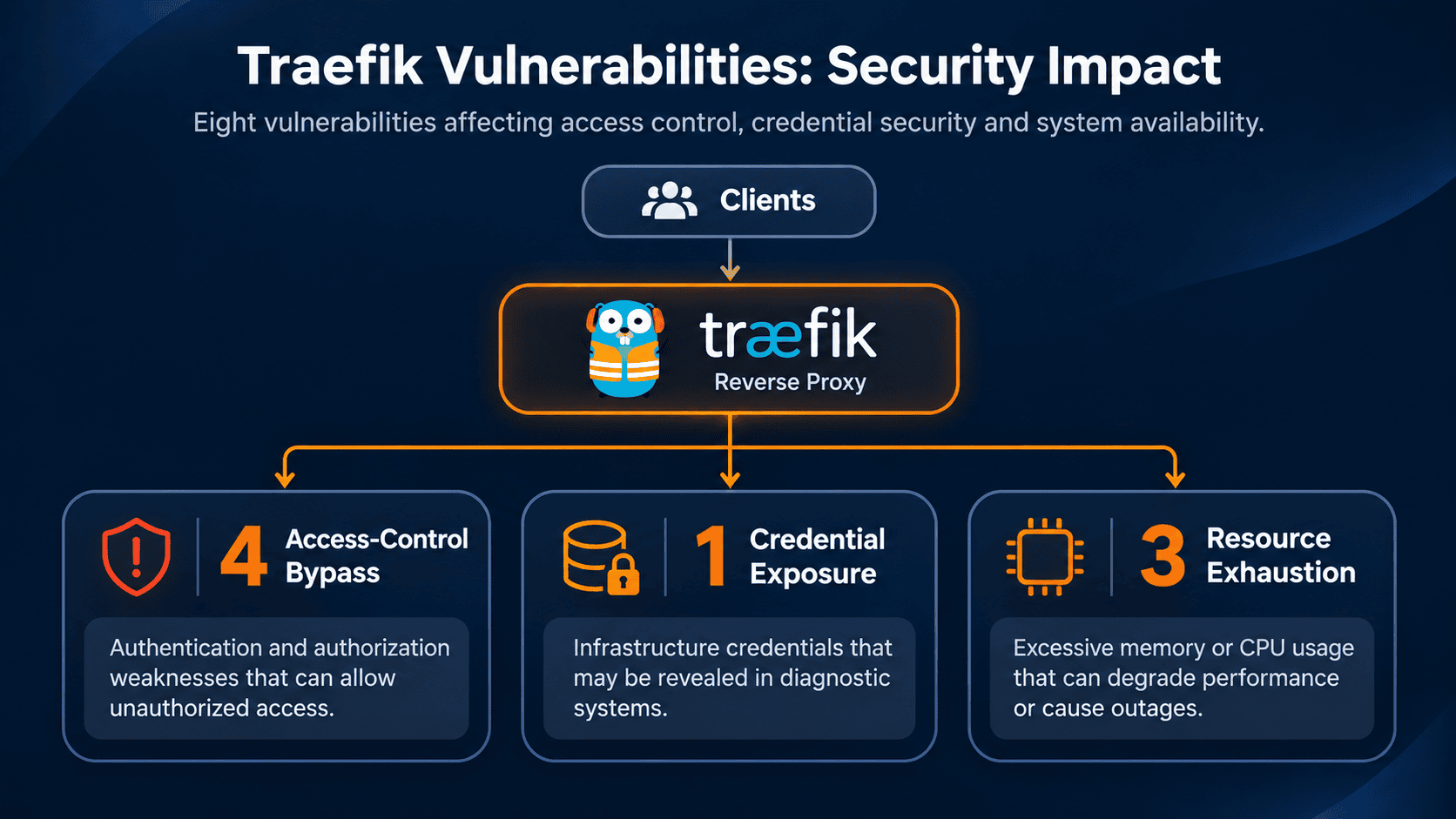
The November security disclosures expose weaknesses across three fundamental areas of infrastructure security:
- Authentication and authorization: Unauthorized clients may gain access to protected resources under specific conditions.
- Confidentiality: Sensitive provider credentials may appear in diagnostic systems.
- Availability: Excessive CPU or memory consumption may disrupt application access.
The November security timeline
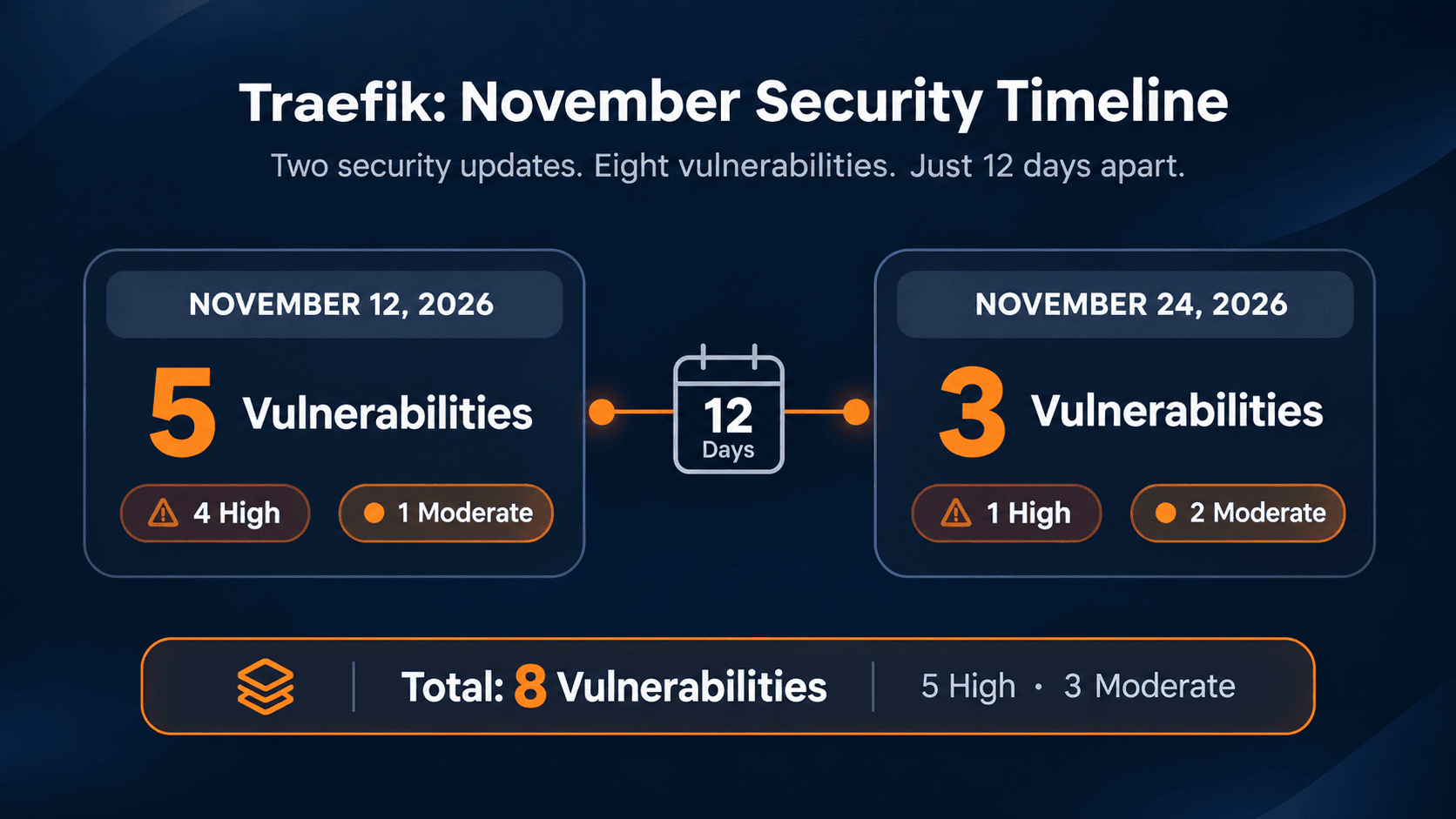
| Date | Vulnerabilities | High | Moderate |
|---|---|---|---|
| November 12, 2026 | 5 | 4 | 1 |
| November 24, 2026 | 3 | 1 | 2 |
| Total | 8 | 5 | 3 |
The vulnerabilities affect different components and configurations. Running a vulnerable version does not necessarily mean that every documented attack scenario applies to your deployment.
Nevertheless, an exposed reverse proxy should never be left unpatched simply because a particular vulnerable feature appears unused.
November 12: Five Vulnerabilities Affecting Traefik
The first security update addressed authentication bypass, client identity verification, URL path handling and resource exhaustion vulnerabilities.
1. ForwardAuth Authentication Bypass
Advisory: GHSA-p956-6gvv-mxqp
Severity: High
Traefik's ForwardAuth middleware delegates authentication decisions to an external authentication service before allowing requests to reach backend applications.
The vulnerability affects authentication mechanisms such as NTLM and SPNEGO/Negotiate, where authentication state can be associated with an established connection.
An incomplete security fix allowed certain authentication requests to continue using shared connections to the authentication service.
Under affected conditions, authentication state associated with one client could incorrectly be reused by another.
This breaks an essential security assumption: a successful authentication decision must belong to the client making the request.
Potential impact:
- Unauthorized access to protected applications.
- Cross-user identity confusion.
- Access to resources under another user's authenticated identity.
Who should be concerned?
Administrators using ForwardAuth with connection-bound authentication systems, including relevant Microsoft IIS Windows Authentication environments.
Patched versions: v2.11.62, v3.7.18 and v3.8.0-rc.2.
Where immediate patching is not possible, consult the official advisory regarding restrictions on the Proxy-Authorization header.
2. Path-Based Authorization Bypass
Advisory: GHSA-cp28-5662-543f
Severity: High
Reverse proxies and backend applications do not always interpret incoming URL paths in exactly the same way.
Traefik's sanitizePath functionality is responsible for normalizing request paths before routing decisions are made.
In vulnerable versions, certain path segments containing parameters were not normalized consistently with how some backend applications process those paths.
This creates a discrepancy between the route Traefik authorizes and the resource the backend ultimately serves.
Under specific configurations, a request could bypass authentication middleware associated with a protected route.
Applications built on Java Servlet containers, Spring-based frameworks and other systems that remove path parameters during request processing may be particularly relevant.
Potential impact:
- Unauthorized access to protected endpoints.
- Bypass of middleware-based authentication.
- Exposure of resources assumed to be inaccessible.
Patched versions: v2.11.62, v3.7.18 and v3.8.0-rc.2.
The broader lesson is important: application authorization should not depend exclusively on the reverse proxy's interpretation of a URL.
3. Kubernetes Client Certificate Verification Bypass
Advisory: GHSA-ccgh-9g52-6vwg
Severity: High
Mutual TLS (mTLS) strengthens authentication by requiring clients to establish their identity through digital certificates.
A vulnerability in Traefik's Kubernetes Ingress NGINX compatibility provider affected environments where multiple Ingress resources shared a hostname.
Under vulnerable conditions, backend applications could receive client identity information and an apparently successful certificate verification result without the corresponding certificate being properly verified.
This undermines the trust relationship between the reverse proxy and applications relying on certificate-based identity headers.
Potential impact:
- Client identity spoofing.
- Certificate-based authentication bypass.
- Unauthorized access to applications relying on forwarded identity information.
Affected deployments: Relevant Ingress NGINX configurations running Traefik v3.7.15 through v3.7.17 or the affected v3.8 release candidate.
Traefik v2 is not affected by this vulnerability.
Patched versions: v3.7.18 and v3.8.0-rc.2.
Administrators should review shared hostname configurations and verify that applications receive trustworthy client identity information.
4. Zstandard Compression Memory Exhaustion
Advisory: GHSA-x5pf-cqh3-2gv8
Severity: High
Zstandard, commonly known as Zstd, is a compression algorithm designed to reduce response sizes while maintaining efficient performance.
The vulnerable implementation of Traefik's Compress middleware retains approximately 18 MiB of encoder memory for each unfinished Zstandard-compressed response.
As concurrent responses accumulate, memory consumption can grow significantly.
An unauthenticated client could contribute to resource exhaustion, potentially disrupting the reverse proxy and the applications behind it.
Potential impact:
- Excessive memory consumption.
- Out-of-memory (OOM) termination.
- Container restart loops.
- Application and infrastructure outages.
The vulnerability affects relevant Traefik v3 deployments using Zstandard compression. Traefik v2 is not affected.
Patched versions: v3.7.18 and v3.8.0-rc.2.
Resource limits and monitoring can help contain operational consequences, but they do not resolve the underlying vulnerability.
5. BasicAuth CPU Exhaustion
Advisory: GHSA-rr42-h8r2-f28g
Severity: Moderate
Authentication mechanisms must process untrusted input before deciding whether a client is authorized.
If that processing consumes excessive computational resources, authentication itself can become a denial-of-service vector.
Traefik's BasicAuth middleware lacked an appropriate password length restriction before verification.
When using MD5-crypt password hashes, unusually long passwords could substantially increase CPU consumption during authentication.
Because the resource-intensive processing occurs before authentication succeeds, valid credentials are not required to trigger the vulnerable behavior.
Potential impact:
- Elevated CPU utilization.
- Increased request latency.
- Reduced proxy availability.
- Degraded performance across hosted applications.
Patched versions: v2.11.62, v3.7.18 and v3.8.0-rc.2.
Administrators should upgrade and review their continued use of legacy password hashing formats.
November 24: Three More Traefik Vulnerabilities
Just twelve days after the first security update, Traefik disclosed three additional vulnerabilities.
The second release addressed another compression-related denial-of-service issue, sensitive credential exposure and a weakness in TLS security policy enforcement.
6. Brotli Compression Memory Exhaustion
Advisory: GHSA-3rh5-223h-cpwr
Severity: High
Brotli is a widely used compression algorithm that helps reduce bandwidth consumption and improve web performance.
Similar to the Zstandard vulnerability disclosed on November 12, Traefik's Brotli implementation retained substantial memory for unfinished compressed responses.
Under affected conditions, excessive concurrent response processing could exhaust available memory and interrupt service delivery.
Brotli is enabled by default within the Compress middleware. This does not mean every Traefik installation uses compression: the middleware must be configured and applied to relevant routes.
Potential impact:
- Memory exhaustion.
- Reverse proxy termination.
- Application unavailability.
- Disruption across multiple hosted services.
Traefik v2 is not affected by this vulnerability.
Patched versions: v3.7.20 and v3.8.0.
If immediate upgrading is impractical, temporarily disabling Brotli compression may reduce exposure to this specific issue.
7. Infrastructure Provider Credential Exposure
Advisory: GHSA-42x2-976f-ph52
Severity: Moderate
Infrastructure credentials can potentially provide access to container management systems, configuration services and other sensitive resources.
A configuration redaction vulnerability in Traefik v3 allowed certain provider credentials to appear without appropriate masking in diagnostic output.
The affected information includes:
- Docker and Swarm provider passwords.
- Knative provider authentication tokens.
- HTTP configuration provider headers.
These sensitive values could appear in debug logs. HTTP provider headers could additionally reach support dumps and anonymous usage statistics.
The actual security impact depends on the permissions associated with those credentials and who can access the affected diagnostic information.
Traefik v2 is not affected.
Patched versions: v3.7.20 and v3.8.0.
Why upgrading alone is not enough
Installing a security update prevents further exposure through the identified vulnerability. It does not remove credentials that may already have been recorded.
Infrastructure teams should investigate:
- Historical container and service logs.
- Centralized logging platforms.
- Previously generated support archives.
- Relevant telemetry exposure.
- Access permissions associated with affected credentials.
Rotate or revoke potentially exposed credentials and review access to historical diagnostic information.
Preserve relevant evidence until any necessary incident investigation is complete.
A patched proxy does not make a previously exposed credential trustworthy again.
8. TLS Security Policy Conflict Bypass
Advisory: GHSA-9657-c2gv-wjpj
Severity: Moderate
Traefik allows administrators to associate hostnames with TLS options, including requirements for client certificate authentication.
The vulnerability originates from inconsistent handling of equivalent hostname representations during routing and TLS configuration conflict detection.
Under specific circumstances, conflicting router configurations could evade existing security checks, potentially undermining certificate-based protection.
Even configurations using strictTLSOptions were not fully protected against this behavior.
Unlike the compression-related vulnerabilities, this issue requires the ability to introduce or modify relevant routing configuration.
This makes shared infrastructure and multi-tenant environments particularly important to review.
Potential impact:
- Bypass of client certificate requirements.
- Inconsistent TLS policy enforcement.
- Unauthorized access to services protected by mTLS.
Patched versions: v2.11.64, v3.7.20 and v3.8.0.
Administrators should upgrade, restrict routing configuration privileges and enforce clear ownership of protected hostnames.
Which Traefik Versions Are Affected?
The November security updates apply to different versions and functionality.
The following table summarizes the affected major release families for the eight vulnerabilities discussed in this article.
| Vulnerability | Traefik v2 | Traefik v3 |
|---|---|---|
| ForwardAuth authentication bypass | Yes | Yes |
| Path authorization bypass | Yes | Yes |
| Client certificate verification bypass | No | Yes |
| Zstandard memory exhaustion | No | Yes |
| BasicAuth CPU exhaustion | Yes | Yes |
| Brotli memory exhaustion | No | Yes |
| Provider credential exposure | No | Yes |
| TLS policy conflict bypass | Yes | Yes |
A "Yes" indicates that affected releases exist within that major version family. It does not mean that every release or configuration is vulnerable.
Consult the individual advisories for exact affected version ranges.
Which version should you upgrade to?
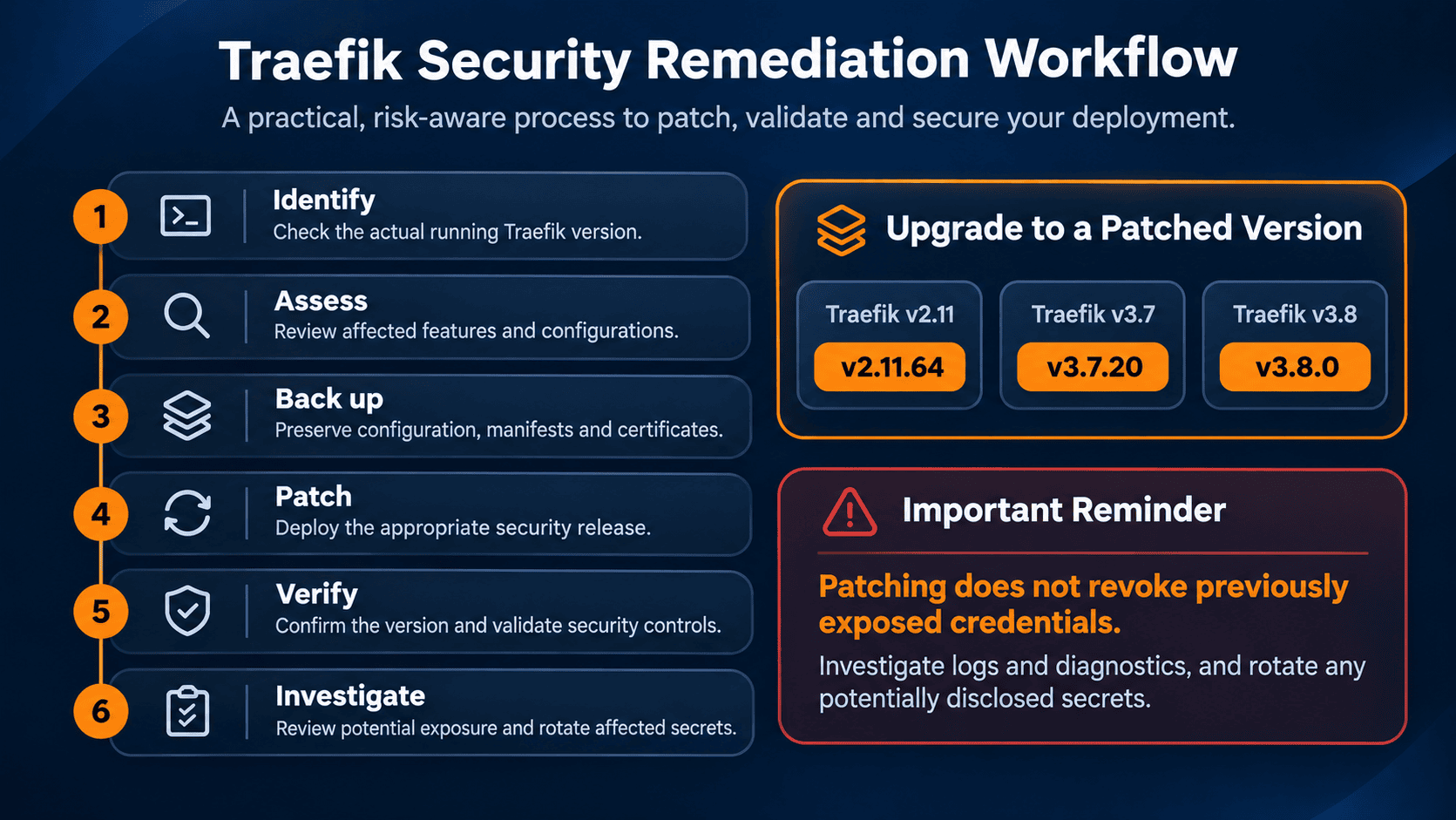
| Release branch | November 12 patch | November 24 patch |
|---|---|---|
| v2.11 | v2.11.62 | v2.11.64 |
| v3.7 | v3.7.18 | v3.7.20 |
| v3.8 | v3.8.0-rc.2 | v3.8.0 |
As of November 27, 2026, the November 24 releases address the vulnerabilities applicable to their respective branches across both security announcements.
Traefik Labs has confirmed that v3.6 and earlier v3 branches will not receive the November 24 security fixes.
Administrators running these older releases should migrate to an appropriate maintained version.
Important: If you upgraded on November 12, do not assume your infrastructure is protected against the vulnerabilities disclosed on November 24.
Check the official Traefik releases for subsequent security updates before deploying.
How to Check if Your Traefik Deployment Is Vulnerable
Before planning remediation, establish which version is actually running and which vulnerable features your environment uses.
Standalone Linux installation
Check the installed version:
traefik version
For systemd-managed installations, inspect the service configuration:
systemctl cat traefik
Confirm that the running service uses the executable whose version you inspected.
Docker and Docker Compose
Identify running containers:
docker ps --format 'table {{.Names}}\t{{.Image}}\t{{.Status}}'
Check the Traefik version inside the container:
docker exec traefik traefik version
Replace traefik with the actual container name.
Kubernetes
Identify relevant workloads:
kubectl get deployments,daemonsets -A | grep -i traefik
Check the version inside a running pod:
kubectl exec -n <namespace> <traefik-pod> -- traefik version
Replace the namespace and pod name with the appropriate values.
Inspect every relevant replica, particularly during or after rolling updates.
Assess your configuration
Review whether your infrastructure uses:
- ForwardAuth with NTLM or Negotiate authentication.
- Public and protected routes sharing a backend.
- Kubernetes Ingress NGINX client certificate authentication.
- BasicAuth with legacy MD5-crypt hashes.
- Brotli or Zstandard compression.
- Sensitive external provider credentials.
- Hostname-specific TLS policies and shared routing resources.
The running version establishes potential software exposure. Your configuration determines which vulnerable behaviors are relevant to your environment.
How to Patch Traefik Without Compromising Production
A reverse proxy update affects a shared infrastructure component. An unsuccessful deployment could interrupt every application behind it.
Follow a controlled remediation process.
Step 1: Preserve your existing configuration
Securely back up relevant configuration files, deployment manifests, Helm values, certificate storage and referenced secrets.
Review release notes and compatibility requirements before upgrading.
Backups containing credentials or private keys must be appropriately protected.
Step 2: Deploy a patched release
For an existing Docker Compose deployment on the v3.7 branch, update the Traefik image reference:
services:
  traefik:
    image: traefik:v3.7.20
This is an illustrative configuration change, not a complete Compose file. Preserve existing networks, volumes, ports and security settings.
Pull the updated image and recreate the service:
docker compose pull traefik
docker compose up -d --no-deps traefik
For Kubernetes environments, update the image or Helm chart through your existing deployment process.
If you use GitOps, update the source repository rather than making unmanaged changes to running resources.
Remember that Helm chart versions and Traefik application versions are separate identifiers.
Step 3: Verify the running version
For Docker Compose:
docker compose exec traefik traefik version
For Kubernetes deployments:
kubectl rollout status deployment/traefik -n <namespace>
Verify the application version inside the updated pods as well.
A successful rollout confirms deployment progress, but it does not independently establish that the correct security-patched binary is running.
Step 4: Validate application and security behavior
After upgrading, verify:
- HTTP and HTTPS routing.
- Authentication and authorization decisions.
- Rejection of unauthorized requests.
- Client certificate requirements.
- Compression behavior.
- CPU and memory utilization.
- Application availability and error rates.
Perform security validation only against systems you own or are authorized to test.
Step 5: Investigate historical exposure
Review authentication records, configuration changes, resource utilization and historical diagnostic logs.
Prioritize unusual authentication activity, unexplained memory growth, unexpected restarts and potentially exposed provider credentials.
These observations are investigation indicators rather than definitive evidence of exploitation.
Where credential exposure is suspected, rotate affected secrets and assess the systems those credentials could access.
Traefik Security Hardening Checklist
Security patches address known vulnerabilities. Infrastructure hardening reduces the potential consequences of future weaknesses.
| Security area | Recommended action |
|---|---|
| Authentication | Enforce authorization independently within sensitive applications. |
| Compression | Enable only the compression algorithms you need. |
| Kubernetes RBAC | Restrict permissions to modify routing and TLS resources. |
| Credential management | Apply least privilege and rotate potentially exposed secrets. |
| Diagnostic logging | Avoid unnecessary debug logging and restrict log access. |
| Resource management | Monitor CPU, memory, latency and container restarts. |
| Network isolation | Prevent unauthorized direct access to backend services. |
| Release management | Track security advisories and maintain supported versions. |
These controls complement software patching. They are not substitutes for it.
The objective is to prevent a single vulnerable infrastructure component from becoming a widespread security or availability incident.
Frequently Asked Questions
How many Traefik vulnerabilities were disclosed on November 12 and 24, 2026?
Eight vulnerabilities were addressed across the two security updates. Five were classified as high severity and three as moderate.
What Traefik versions contain the November 24 security fixes?
Traefik v2.11.64, v3.7.20 and v3.8.0 contain the applicable fixes announced on November 24, 2026. Use the appropriate supported release or a subsequent version containing those fixes.
I updated Traefik on November 12. Do I need to update again?
Yes. The November 24 release addresses additional vulnerabilities that were not resolved by the November 12 security update.
Are Traefik v2 deployments affected?
Yes. Affected v2 releases exist for the ForwardAuth authentication bypass, path authorization bypass, BasicAuth CPU exhaustion and TLS policy conflict vulnerabilities. The remaining four vulnerabilities discussed here are specific to affected v3 releases.
Do these Traefik vulnerabilities have CVE numbers?
The official security announcements identify the vulnerabilities using GitHub Security Advisory (GHSA) identifiers. Consult each linked advisory for any corresponding CVE assignments. Remediation should not be delayed while waiting for a CVE identifier.
Are these vulnerabilities being actively exploited?
The vendor announcements referenced in this article do not establish widespread active exploitation. However, administrators should prioritize remediation rather than wait for evidence of attacks against their own infrastructure.
Does updating the host operating system patch Traefik?
Not necessarily. Docker and Kubernetes installations require updating the relevant container images and replacing the affected running workloads. Host operating system updates do not automatically update containerized Traefik deployments.
Does patching Traefik remove previously exposed credentials?
No. Previously disclosed credentials may remain in logs, support archives or external systems. Investigate potential exposure, rotate affected credentials and review access permissions separately.
Final Thoughts: Secure the Infrastructure That Secures Your Applications
The November 12 and November 24 Traefik disclosures highlight an often-overlooked infrastructure risk.
The systems responsible for protecting applications can themselves become a source of vulnerability.
When a reverse proxy handles authentication, TLS policies, routing and traffic management for multiple services, a weakness in that component can have consequences across the entire environment.
The appropriate response is not simply to update a version number.
Identify your exposure. Deploy the appropriate security patches. Verify your access controls. Investigate potentially exposed credentials. Maintain visibility into infrastructure health.
At ShellSecrets, we believe infrastructure security is an ongoing operational responsibility, not a one-time configuration task.
If your business relies on Docker, Kubernetes, cloud servers or internet-facing applications, now is the time to review the security of your reverse proxy and the infrastructure behind it.
Because the security of your applications depends, in part, on the infrastructure standing between them and the internet.