What is DevOps? A Beginner’s Guide for Businesses in Nepal

Digital transformation is changing how businesses operate in Nepal. Companies are now focusing on faster software delivery, better infrastructure management, and reliable cloud systems. This is where DevOps becomes important.
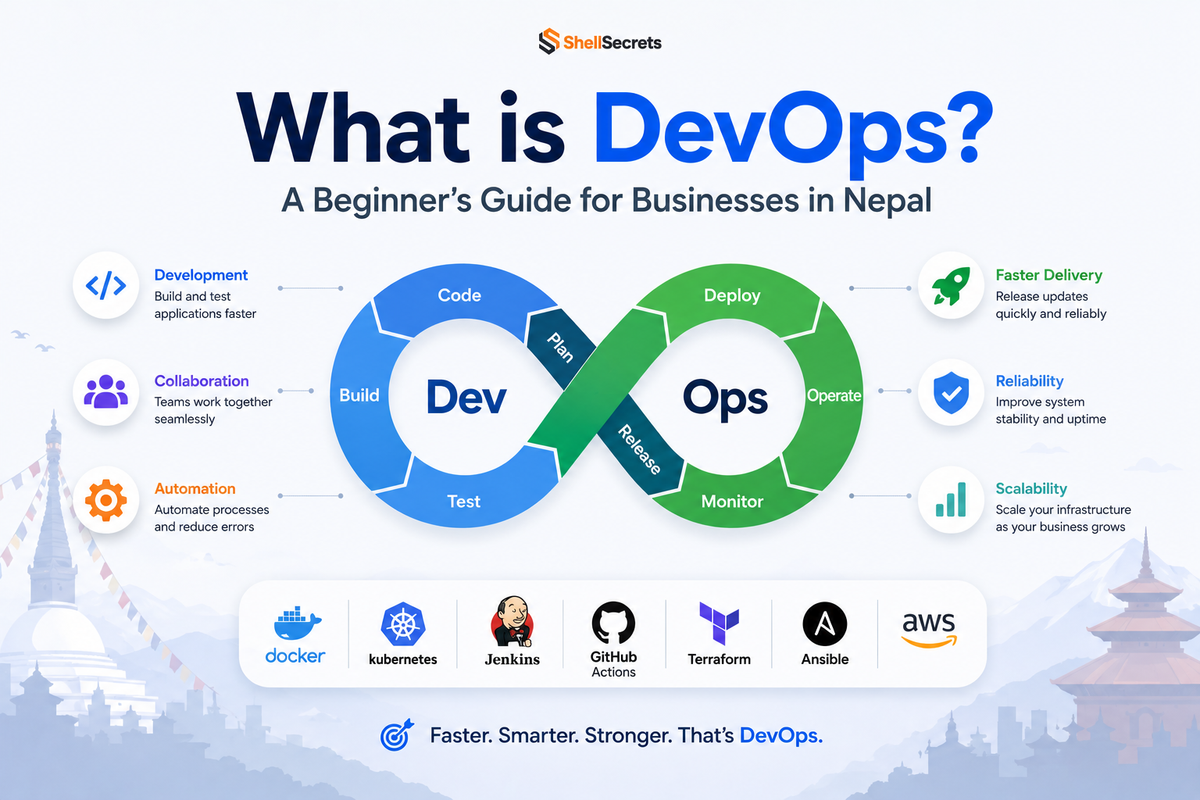
DevOps is a modern IT approach that combines software development (Dev) and IT operations (Ops). The goal is to improve collaboration, automate workflows, and deliver applications faster and more securely.
Traditionally, developers and operations teams worked separately. Developers created applications while operations teams managed servers and deployments. This often caused delays, communication problems, and deployment failures.
DevOps solves these issues by creating a continuous workflow where development, testing, deployment, and monitoring happen efficiently together.
Key Benefits of DevOps
Faster Deployment
Businesses can release updates and applications more quickly.
Better Collaboration
Developers and infrastructure teams work together effectively.
Improved Security
Automation reduces human errors and improves infrastructure security.
High Availability
Monitoring tools help detect and resolve issues faster.
Scalability
Cloud-native DevOps environments can easily scale with business growth.
Popular DevOps Tools
- Docker
- Kubernetes
- Jenkins
- GitHub Actions
- Terraform
- Ansible
- AWS DevOps Services
Why Businesses in Nepal Need DevOps
As Nepali businesses move toward cloud infrastructure and online services, DevOps helps organizations:
- Improve software delivery
- Reduce downtime
- Manage infrastructure efficiently
- Scale applications faster
DevOps is especially useful for:
- SaaS startups
- eCommerce businesses
- Cloud hosting companies
- Fintech platforms