CVE-2026-97631: Critical UEFI Firmware Flaw Exposes Servers to Pre-Boot Code Execution


Introduction
A server can have a fully patched operating system, properly configured firewall rules, endpoint monitoring, and Secure Boot enabled—and still be vulnerable before any of those protections have an opportunity to work.
That is the concern raised by CVE-2026-97631, a critical vulnerability discovered in the UEFI firmware code used to initialize and boot many modern servers.
Disclosed by the TianoCore project on October 22, 2026, the vulnerability carries a CVSS 4.0 severity score of 9.5 out of 10. It affects the PXE network-boot driver in EDK II, a widely adopted open-source implementation of UEFI firmware components.
Under specific conditions, an unauthenticated attacker can send a specially crafted network message to a machine during PXE boot, corrupt firmware memory, and potentially execute arbitrary code before the operating system loads.
The vulnerability has attracted considerable attention because EDK II is used throughout the server and virtualization ecosystem. However, the actual exposure is more specific than some headlines suggest: the vulnerable network-boot functionality must be active, and an attacker must be able to reach the machine during the boot process.
For hosting providers, data centers, and organizations that rely on automated server provisioning, that distinction is particularly important.
Executive Summary
CVE-2026-97631 is a memory corruption vulnerability in the EDK II PXE Base Code driver, specifically within its handling of Internet Control Message Protocol (ICMP) error messages.
The affected code can copy oversized network messages beyond the boundaries of an allocated memory buffer, potentially allowing an attacker to interfere with firmware execution.
| Attribute | Details |
|---|---|
| CVE identifier | CVE-2026-97631 |
| Severity | Critical |
| CVSS 4.0 score | 9.5/10 |
| Affected component | TianoCore EDK II PXE Base Code driver |
| Vulnerability type | Out-of-bounds write / buffer overflow |
| Attack vector | Crafted ICMP error message during PXE boot |
| Potential impact | Pre-boot code execution or denial of service |
| Authentication required | No |
| Official disclosure | October 22, 2026 |
| Patch status | Source-code correction available; no patched stable EDK II release listed as of October 29, 2026 |
The official TianoCore security advisory provides the technical details and identifies the affected component.
Understanding UEFI, EDK II, and PXE Network Boot
Why Firmware Security Matters
Most security discussions focus on operating systems, web applications, databases, and network services. Firmware receives comparatively less attention, even though it plays a foundational role in how computers operate.
Unified Extensible Firmware Interface (UEFI) is responsible for initializing hardware and preparing the system to load an operating system.
When a server powers on, its firmware executes before Linux, Windows, or another operating system becomes active.
This creates an important security boundary. A vulnerability exploited during firmware execution can potentially operate outside the visibility of conventional operating-system security tools.
EDK II, maintained by TianoCore, provides open-source firmware development components used by hardware manufacturers, virtualization platforms, and other infrastructure projects.
Not every UEFI implementation contains the same code or exposes the same functionality. Nevertheless, the broad adoption of EDK II makes vulnerabilities in its core components significant.
What Is PXE Boot?
Preboot Execution Environment (PXE) allows a computer to boot using resources provided over a network rather than relying exclusively on a locally installed operating system.
This capability is especially useful in data centers.
A hosting provider may use PXE to provision hundreds of bare-metal servers automatically. An infrastructure team might use it to reinstall operating systems, recover failed machines, or deploy standardized server images.
PXE is also common in automated infrastructure workflows where physical servers need to be deployed or rebuilt with minimal manual intervention.
The convenience comes with an additional attack surface: firmware must process network traffic before the operating system and its usual security controls are available.
CVE-2026-97631 targets precisely this stage.
Technical Analysis: How CVE-2026-97631 Works
The vulnerability resides in the EDK II network package, within the NetworkPkg/UefiPxeBcDxe driver.
During PXE boot, this driver handles network communication and receives ICMP error messages associated with the boot process.
According to the official advisory, the driver stores these messages in a fixed 504-byte buffer, identified as Mode.IcmpError.
The problem arises when the driver receives a message larger than the available buffer space.
Due to incorrect bounds handling, the implementation may continue copying incoming data beyond the allocated memory region. The flaw affects both IPv4 and IPv6 ICMP processing paths.
The advisory also identifies an incorrect pointer calculation involving cumulative fragment lengths, further contributing to the out-of-bounds write.
In ordinary application code, this type of programming error might crash a process or corrupt its memory. Inside UEFI firmware, however, the consequences can be considerably more serious.
The affected driver executes during the Driver Execution Environment (DXE) phase, where firmware components have extensive control over system initialization.
An attacker who successfully manipulates memory at this stage may interfere with firmware execution before the operating system starts.
The TianoCore advisory describes two important outcomes: a predictable firmware crash that interrupts network boot, and a more advanced code-execution scenario involving manipulation of internal firmware event structures.
The latter requires knowledge of the target firmware build and favorable exploitation conditions. It should not be interpreted as guaranteed code execution against every affected machine.
Simplified Attack Sequence
The following illustration explains the attack at a conceptual level.
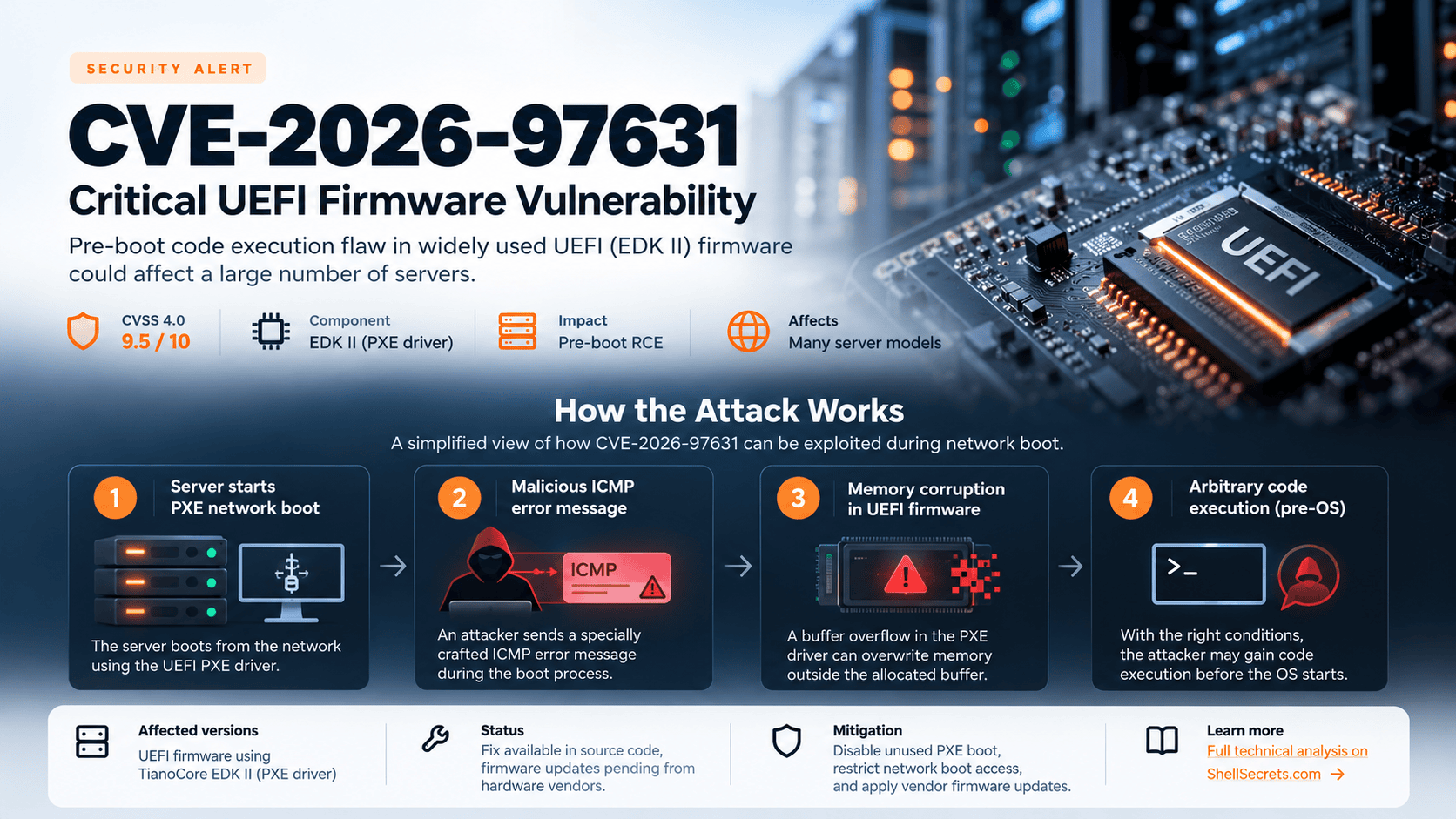
Figure: Simplified attack sequence for CVE-2026-97631. The attack requires a vulnerable PXE boot environment and the ability to deliver malicious network traffic during the boot process.
Stage 1: A Server Begins PXE Network Boot
The targeted server starts its firmware-controlled network-boot process. Its PXE driver becomes active and begins communicating over the network.
This creates a limited window during which the vulnerable firmware component processes incoming messages.
Stage 2: A Crafted ICMP Message Reaches the Server
An unauthenticated attacker capable of delivering traffic to the booting machine sends an oversized ICMP error message.
The malicious message is designed to trigger the vulnerable buffer-handling logic.
The official advisory describes a network-reachable attack vector; the attacker does not necessarily need physical access to the server. Actual reachability depends on the network configuration and filtering controls.
Stage 3: Firmware Memory Becomes Corrupted
When the PXE driver processes the oversized message, the vulnerable copy operation can write data beyond its intended destination.
This corrupts memory used by the firmware.
Depending on the contents of the message and the target environment, the immediate result may be a firmware exception or a failed boot.
Stage 4: Potential Pre-Boot Code Execution
Under more specific conditions, an attacker familiar with the target firmware build may manipulate internal execution structures and cause attacker-controlled code to execute during the DXE phase.
At this point, the operating system has not loaded, and operating-system security software cannot inspect the activity as it normally would.
This is what makes the vulnerability especially concerning for infrastructure operators.
Why Secure Boot Does Not Eliminate the Risk
Secure Boot is an important defense against unauthorized bootloaders and other malicious components in the operating-system boot chain.
However, Secure Boot does not guarantee that every firmware component executing before those checks is free from vulnerabilities.
CVE-2026-97631 can be triggered while vulnerable UEFI code is already running during PXE initialization.
The memory corruption occurs before Secure Boot or measured boot has verified or measured the relevant operating-system components.
Consequently, enabling Secure Boot alone does not prevent exploitation of this particular flaw.
That does not make Secure Boot ineffective or unnecessary. It remains an important part of a layered security strategy, but it cannot replace firmware updates and network-level protection for vulnerable PXE environments.
Which Servers and Systems Are Affected?
The vulnerability affects EDK II implementations containing the vulnerable PXE driver, including code present in EDK II releases through edk2-stable202608.
Because EDK II is used as a foundation for numerous firmware implementations, the potential reach extends across physical servers and certain virtualized environments.
However, the presence of EDK II does not automatically establish that a specific motherboard or server model is vulnerable.
Manufacturers may modify the reference implementation, omit particular components, or maintain independent patches.
The most relevant environments include bare-metal hosting platforms, data centers using network-based provisioning, automated server deployment infrastructure, recovery environments, and virtual machines using affected EDK II-derived firmware such as OVMF.
Are Already-Running Servers Vulnerable?
This is one of the most important distinctions.
A server that has already completed booting is not directly exposed to this particular attack while it continues normal operation.
The vulnerable condition exists during the PXE network-boot process.
Similarly, a machine that boots exclusively from local storage and never executes the affected PXE code does not expose the described attack path.
Nevertheless, organizations should not assume that a server is unaffected simply because PXE is not part of its everyday operation.
Network boot may still be enabled as a fallback, recovery, or remote provisioning option.
Administrators should verify actual firmware configurations rather than relying on assumptions.
Why This Matters for Hosting Providers and Cloud Infrastructure
The vulnerability is especially relevant to companies operating physical server infrastructure.
Modern hosting environments depend heavily on automation. Bare-metal machines may be provisioned, reinstalled, repaired, and returned to service through network-based workflows.
In such environments, PXE is not an obscure legacy feature. It is often a practical component of infrastructure management.
An attacker who can interfere with network boot could potentially disrupt provisioning operations, delay server recovery, or compromise a machine before its operating system becomes active.
For providers managing large numbers of servers, even a denial-of-service outcome could have operational consequences.
A compromised firmware execution environment may also create opportunities for further attacks, although the actual impact would depend on the target configuration and the attacker's capabilities.
The disclosure has already prompted attention from infrastructure operators. For organizations managing their own servers, the lesson is straightforward: firmware security must be included in infrastructure vulnerability management, not treated as a separate concern that only hardware manufacturers need to address.
Mitigation and Security Recommendations
At the time of writing, the upstream project has incorporated a source-code correction, but the TianoCore advisory does not yet identify a patched stable EDK II release.
More importantly, an upstream code change does not automatically update the firmware installed on physical servers.
Hardware manufacturers must integrate and distribute appropriate firmware updates, while operators of virtualized environments may need updated EDK II or OVMF packages.
Until applicable updates become available, organizations should focus on reducing exposure.
Audit PXE Boot Configurations
Identify servers and virtual machines that use PXE for provisioning, recovery, or automated installation.
Check whether network boot is enabled as a primary or fallback boot option.
Where PXE is unnecessary, disable the feature through the appropriate firmware configuration.
Isolate Provisioning Networks
PXE traffic should be restricted to controlled infrastructure networks rather than unnecessarily exposed to untrusted systems.
Network segmentation, access controls, and carefully designed traffic filtering can reduce the opportunity for malicious messages to reach booting machines.
Because the vulnerability involves ICMP processing, administrators should review how ICMP traffic reaches provisioning environments without indiscriminately blocking messages required for legitimate network operation.
Monitor Firmware Vendor Advisories
Track security updates from motherboard manufacturers, server vendors, and virtualization platform maintainers.
For physical hardware, use firmware packages supplied by the appropriate manufacturer.
For virtual machines, verify whether the platform uses an affected EDK II-derived firmware implementation and whether a corrected package is available.
The Red Hat vulnerability record and Debian Security Tracker provide additional information for affected software distributions.
Plan Reboots and Recovery Operations Carefully
Where vulnerable systems rely on PXE, avoid unnecessary network-boot cycles until appropriate mitigations are in place.
This does not mean all servers should remain permanently online without maintenance.
Instead, administrators should assess the exposure of each provisioning environment and schedule necessary operations with suitable network protections and recovery procedures.
Maintain Defense-in-Depth
Continue using Secure Boot, least-privilege access, network segmentation, firmware integrity monitoring, and controlled management interfaces.
These controls may not independently eliminate CVE-2026-97631, but they remain valuable for reducing broader infrastructure risk.
Disclosure Timeline and Patch Status
The vulnerability was reported by Alex Matrosov of Anthropic and Dan Holmes-Mitra of Google, who are credited in the official TianoCore advisory.
A source-code fix was merged into the EDK II development branch on October 15, 2026.
The public advisory followed on October 22, 2026, identifying the vulnerability as CVE-2026-97631 and assigning a Critical severity rating of 9.5 under CVSS 4.0.
By October 28, infrastructure providers and security researchers were publicly discussing the operational implications.
As of October 29, the official advisory still lists no patched stable EDK II version.
Organizations should monitor the upstream correction and vendor-specific releases rather than assuming that the existence of a source-code fix means deployed systems are protected.
Final Thoughts
CVE-2026-97631 highlights a security problem that can easily be overlooked: some of the most important software in a server runs before the operating system.
Firmware is responsible for establishing the environment in which every subsequent security control operates. When a vulnerability exists at that level, traditional defenses may have limited visibility into what happens during exploitation.
The broad use of EDK II makes this disclosure significant, particularly for organizations operating bare-metal servers, cloud platforms, and automated provisioning systems.
At the same time, the technical conditions matter. This is not evidence that every server on the internet can be remotely compromised at any moment. The vulnerability requires the affected PXE functionality to execute and malicious network traffic to reach the system during boot.
For infrastructure teams, the immediate priorities are to identify affected environments, secure provisioning networks, disable unnecessary PXE functionality, and prepare for firmware updates.
At ShellSecrets, we view infrastructure security as more than keeping applications and operating systems updated. Reliable hosting also depends on understanding the lower-level components that support the entire platform.
Whether managing cloud hosting, VPS environments, or dedicated server infrastructure, organizations should include firmware exposure in their broader security and operational risk assessments.
CVE-2026-97631 is a reminder that server security begins before the operating system does.