5 Surprising SEO Reasons to Choose Shared Hosting Over a VPS (Even If You Hate Sharing)

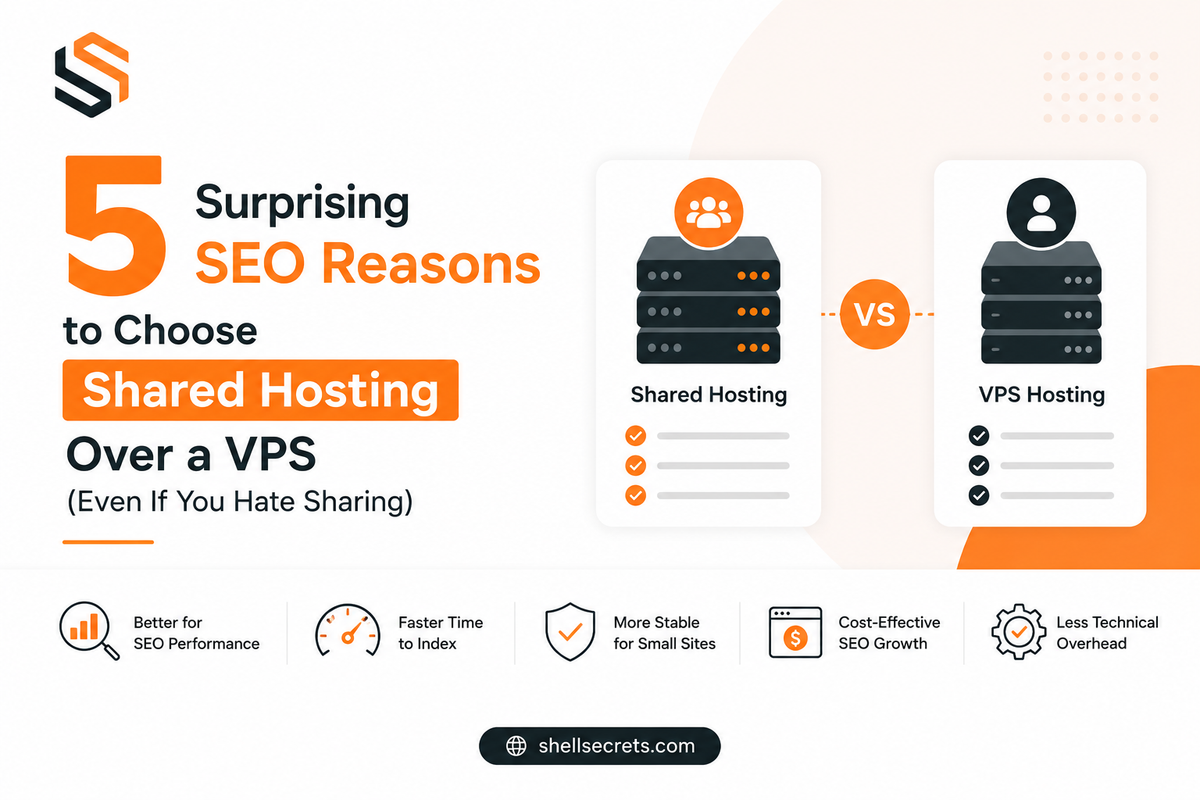
Introduction – The Myth: “VPS = Better SEO.”
It’s one of the most common assumptions in web development: upgrade to a VPS and your SEO will improve. On paper, it sounds logical—more control, dedicated resources, and flexibility.
But in reality, SEO doesn’t care about your hosting type. It cares about outcomes: speed, uptime, security, and user experience.
A poorly configured VPS can actually hurt your rankings more than a well-optimized shared hosting plan. Let’s break down why shared hosting—when chosen wisely—can outperform a VPS in surprising ways.
#1 Crawl Budget Efficiency
Search engines allocate a crawl budget—the number of pages they’ll crawl on your site within a given timeframe.
Why shared hosting can win:
Modern shared hosting providers often include:
- Built-in caching (LiteSpeed, NGINX caching)
- CDN integrations
- Server-level optimizations
These features ensure:
- Faster page delivery
- Reduced server load
- Efficient crawling by bots
VPS downside:
On a VPS, you typically start with a “bare” server:
- No caching configured
- No performance tuning
- Requires manual setup
If misconfigured, your site becomes slower → Google crawls fewer pages → weaker indexing.
#2 Security Without a Sysadmin
Security is a direct SEO factor. If your site is compromised:
- It may get de-indexed
- Users see warnings (“This site may be hacked”)
- Rankings drop instantly
Shared hosting advantage:
Managed shared hosts handle:
- Firewall configuration
- Malware scanning
- Automatic updates
- DDoS protection
VPS reality:
You are responsible for:
- Patching the OS
- Securing SSH access
- Installing firewalls
- Monitoring threats
One missed update = vulnerability.
👉 SEO truth: A secure shared server beats an insecure VPS every time.
#3 Burst Traffic Handling
Traffic spikes can come from:
- Viral content
- Social media
- Google ranking boosts
Shared hosting surprise:
Many providers use:
- Load balancing
- Resource pooling
- Cloud-based scaling
This allows your site to handle sudden spikes smoothly.
VPS limitation:
- Fixed CPU & RAM
- Scaling requires manual upgrade
- Risk of downtime under load
If your site crashes during a traffic spike, you lose:
- Rankings
- Users
- Revenue
# 4 – Lower TTFB (Time To First Byte)
TTFB is a key performance metric for SEO and Core Web Vitals.
Shared hosting strength:
Optimized environments often include:
- LiteSpeed or optimized Apache stacks
- Server-level caching
- Preconfigured PHP and database tuning
Result:
👉 Faster response times out of the box
VPS challenge:
Without optimization:
- Higher TTFB
- Slower initial response
- Poor Core Web Vitals
You can optimize a VPS—but it requires expertise and time.
#5 – Your Time Is Better Spent on Content
SEO is driven primarily by:
- Content quality
- Keyword targeting
- Backlinks
- User engagement
Hidden VPS cost:
Managing a VPS involves:
- Server setup
- Performance tuning
- Security monitoring
- Troubleshooting downtime
That’s hours (or days) lost.
Shared hosting benefit:
- Plug-and-play setup
- Minimal maintenance
- Focus stays on content creation
👉 The best SEO strategy isn’t server tweaking—it’s publishing better content consistently.
When You Actually Need a VPS
Shared hosting isn’t always the answer. You should consider a VPS if:
- Your site has high consistent traffic
- You need custom server configurations
- You run resource-heavy applications
- You require full root access
In short:
👉 Move to VPS when your needs outgrow shared hosting—not before.
8. Conclusion – SEO-Safe Shared Hosting Checklist
If you’re choosing shared hosting for SEO, make sure it offers:
✅ Built-in caching (LiteSpeed/NGINX)
✅ Free CDN integration
✅ High uptime guarantee (99.9%+)
✅ Strong security features
✅ Fast server response times
✅ Data centers near your audience
✅ Good reputation (avoid overcrowded hosts)